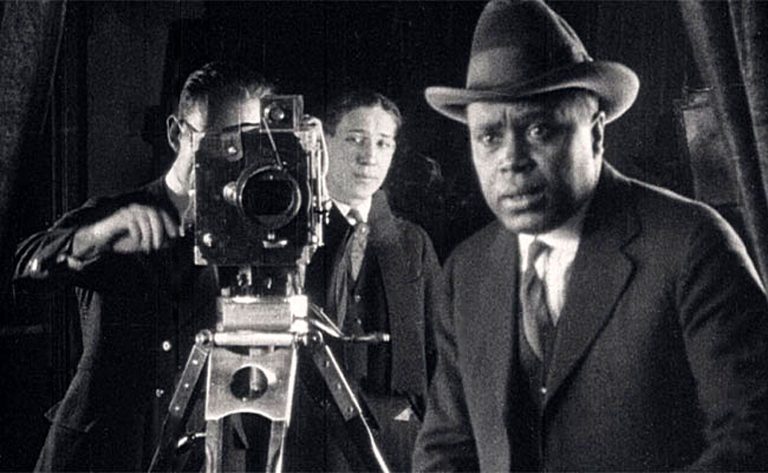
Oscar Micheaux Biography
Before Hollywood had gates, Oscar Micheaux was looking for ways around them. At a time when Black Americans were either excluded from the screen or mocked on it, Oscar Micheaux built his own path into the film industry. Micheaux produced and directed over 40 films to become the first major African American filmmaker.
Early Life
Oscar Devereaux Micheaux was born on January 2, 1884, in Metropolis, Illinois, one of eleven children born to formerly enslaved parents. His upbringing was strict, practical, and shaped by the realities of post-Reconstruction America. His family then moved to Kansas, where he grew up.
He left home at around the age of 16 and worked a series of labor jobs before becoming a porter on the railroads. It allowed him to travel the country and observe, firsthand, the vast differences in how Black Americans lived from region to region.
In 1904, Micheaux filed a claim under the Homestead Act and moved to Gregory County, South Dakota, becoming a homesteader on the open plains. The isolation, hardship, and racial tension with the mostly white area he experienced there would later form the backbone of his writing and filmmaking.
Micheaux began writing novels while living in South Dakota to reflect the hardships of Black Americans at the time. He self-published his first book, The Conquest: The Story of a Negro Pioneer, in 1913, followed by The Homesteader in 1917. He went door to door selling his books himself, learning the mechanics of marketing and distribution. This was his first lesson in bypassing gatekeepers. But he soon realized books were not enough. Motion pictures reached people faster and more widely.
Career
In 1918, Micheaux founded the Micheaux Book and Film Company. In 1919, he wrote, produced, and directed his first film, The Homesteader (1919), starring actress and singer Evelyn Preer. The film was an adaptation of his novel of the same name. He raised money directly from black communities to fund the film. It became the first feature-length film directed by an African American. Unfortunately, no copies of the film remain. What followed was an extraordinary run of independent filmmaking that predated modern indie cinema by nearly a century.
In 1920, he made Within Our Gates (1920), his direct response to The Birth of a Nation (1915) by D. W. Griffith, a film that glorified the Ku Klux Klan and cemented racist caricatures into American film language. Within Our Gates follows the story of a woman whose father is falsely accused of murder and lynched by white men. It also features scenes of sexual assault. The film was added to the National Film Registry by the Library of Congress in 1992.
Micheaux’s films featured mostly black casts and were made for black audiences. His stories dealt with African American life, showing relationships between blacks and whites and many of the challenges African American people in the country dealt with at that time. Much of it was autobiographical. However, he knew the reason audiences went to the movies was for a good story, and as such, Micheaux offered his viewers engaging characters with whom they could identify, along with issues of racial inequality.
He would shoot in empty old studios, as most studios refused to allow him to film there. He would also film in the houses and offices of his acquaintances. The films, in many cases, were technically flawed, as he could not afford reshoots or afford expensive equipment. His budgets ranged between 10 and 20 thousand dollars. A minuscule sum, even in that era of filmmaking. However, a large sum when funding a film oneself.
Because mainstream distributors would not release his work, Micheaux developed what could be called suitcase filmmaking. He physically transported film reels from town to town, arranging screenings in segregated theaters, churches, and rented halls. He negotiated directly with theater owners, sometimes securing late-night showings in white-owned venues so black audiences could attend after hours. His distribution network stretched across the country, built entirely through hustle and persistence. To increase box office receipts, he scheduled promotional junkets and encouraged his stars to make personal appearances in the cities where his films were opening.
And, of course, in doing all that, he had to deal with censorship boards that called his films provocative and dangerous. Many local officials tried to ban screenings, claiming his depictions of racial injustice would incite unrest. He also dealt with white-owned cinemas refusing to play his films. Micheaux fought these decisions repeatedly, sometimes editing films just enough to get them shown while preserving the core message. Being the ever salesman, he would use the censorship of his films to help market them. In markets that would allow it, he would promote the screening of the uncensored version of a film.
His final film was The Betrayal (1948). The script was based on his novel The Wind from Nowhere (1941). The film was one of his most expensive productions. One source states the budget at over $100,000. The movie featured many of the same subject matter as his earlier works. However, audiences in the 1940s were not interested in watching a three-hour-long film on the subject. No copies of the film have survived.
Personal Life and Legacy
Micheaux married twice. His first wife was Orlean McCracken. His second was to actress Alice B. Russell in 1926, with whom he stayed married until his death. He died of heart failure on March 25, 1951, in Charlotte, North Carolina. He is buried in Great Bend, Kansas. His gravestone reads: “A man ahead of his time”.
Like a lot of movies throughout history, many of his films were lost due to neglect, poor preservation, or lack of interest at the time. Currently, only three of his silent movies are known to exist: Within Our Gates (1920), Body and Soul (1925), and The Symbol of the Unconquered (1920). What remains, however, is a record of Black life on screen that would not exist without him.
In 1986, at a special ceremony in Hollywood, he was posthumously awarded a Golden Jubilee Special Directorial Award by the Directors Guild of America; he was the first Black filmmaker to receive the honor. He was given a star on Hollywood’s Walk of Fame in 1987.
Today, Oscar Micheaux is recognized as the first major Black filmmaker in American history and a foundational figure in independent cinema. His films stand as both art and archive, capturing communities, struggles, and perspectives that mainstream Hollywood at the time either distorted or ignored.